
The Baltimore Development Corporation —and economic development corporations like the BDC around the country—play a unique role. Our ultimate goal is to help city residents gain more of the financial resources they need to thrive. We do so by identifying economic sectors or physical locations where some amount of public or philanthropic resources—be they time, effort, financial capital, or all three—can fill a gap and spur investments that amount to many times that initial input. At our best, we are a catalyst, identifying and collaborating to correct market failure and channeling resources more equitably.
Taxes are one of the main places private and public interests connect. Taxes translate private economic activity, often enabled by longstanding public infrastructure, into resources that can meet shared needs. Thus time-limited tax incentives can be a powerful tool for inducing economic activity. The incentive reduces the normal tax burden, changing the cost-benefit analysis for project sponsors and enabling developments that otherwise would not happen.
Payments in lieu of taxes (PILOTs) are one tax incentive government can leverage to direct and amplify private capital. The BDC is not a government agency, but we work closely with the City administration to evaluate the economic necessity of proposed PILOT agreements and measure their impact.
What is a Payment In Lieu of Taxes (PILOT)?
A PILOT is exactly what its name suggests: a payment made instead of some or all of the taxes that would otherwise be owed on a property. Under a PILOT agreement, a government and property owner contract that, for a defined period of time, the owner will make payments according to an agreed-upon schedule rather than paying the full amount that would ordinarily be due under the property tax system.
PILOTs can serve different purposes. They can encourage private investment by temporarily reducing the tax burden on a project; provide governments with revenue from institutions or properties that are otherwise exempt from taxation; or, in some cases, help finance a development or related public improvements.
The arrangements vary considerably from place to place, but the underlying idea is straightforward: government establishes an alternative payment structure to accomplish a specific public purpose.
What are some examples of PILOTs?
PILOTs are common in jurisdictions around the country. Here are two examples.
Boston’s Prudential Center. Boston has used PILOT-style tax agreements under Massachusetts’ Chapter 121A to encourage redevelopment of blighted properties. The Prudential Center, one of Boston’s most recognizable developments, has operated under such an arrangement, replacing conventional property taxes with alternative payments.
The Tennessee Valley Authority. Because the federally owned Tennessee Valley Authority is exempt from state and local taxes, it makes payments in lieu of taxes to state and local governments across its service area. TVA generally returns 5% of its power revenues to states and localities through these tax-equivalent payments, helping compensate communities for taxes they otherwise cannot collect from the federal utility.
How does a PILOT work?
Although PILOT programs vary, the basic ingredients are relatively simple. First, government needs the legal authority to offer an alternative to the normal property-tax treatment. Second, an eligible project must be identified and evaluated to determine whether a PILOT advances a public purpose, often by making possible an investment that would otherwise be financially infeasible. Finally, the government and property owner enter into an agreement establishing how much the owner will pay instead of ordinary property taxes, how long the arrangement will last, and any other conditions attached to the incentive.
Baltimore’s Downtown RISE PILOT provides a useful example. In 2026, the Maryland General Assembly passed Senate Bill 756, authorizing Baltimore City to exempt or partially exempt certain new or rehabilitated commercial and multifamily projects within a specifically defined area of downtown from City real property taxes. Eligible developments can include hotels, offices, retail, multifamily housing, and mixed-use projects.
But simply being located within the district does not entitle a development to a PILOT. Before receiving one, the project owner must demonstrate to the satisfaction of Baltimore’s Board of Estimates that the City or its designated agency has conducted an economic analysis of the project, including an assessment of whether the tax exemption is financially necessary. The owner and Board of Estimates must then enter into an agreement specifying how much the owner will pay the City each year in lieu of ordinary City property taxes.
Why is Baltimore leveraging PILOTs?
Each project must successfully make the case for why tax abatement is financially necessary. Government’s role should be catalytic: for example, PILOTs can help rehabilitate assets that currently generate little to no tax revenue.
This point is important. After a project under a PILOT agreement comes online, it is tempting to compare revenue the City would generate under the normal tax rate to the lower, agreed-upon annual payments and refer to that difference as a loss. But that is misleading, because in a properly executed PILOT, if not for the temporarily reduced tax payments, the project would not exist. The greater cost is doing nothing: nothing gets built, so the area in question generates little or even negative revenue, if blight creates an increased need for City-funded maintenance or repair of surrounding public assets, code enforcement, and/or litigation against absentee property owners.
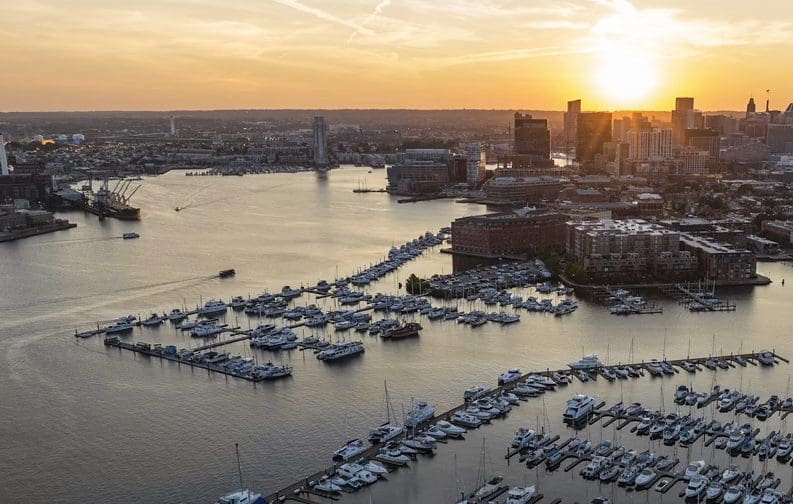
PILOTs are by no means limited to downtown areas, but downtown Baltimore is the city’s economic epicenter, 3.8% of the geographic area responsible for 17% of income tax and 35% of jobs. This concentration of economic activity makes downtown a particularly good example of what PILOTs can achieve.
To remain vital, downtown areas have to be responsive to major shifts in how we live, work, and play. The mix and quality of assets necessary for an urban core to be vibrant and globally competitive have changed and new opportunities have emerged.
Office. After the COVID-19 pandemic and the dramatic growth in remote and hybrid work arrangements, employers, when they use office buildings at all, expect more from them. Class A and highly amenitized space can remain competitive; some obsolete office inventory needs another use.
Residential: Downtown Baltimore, with its access to transit and entertainment, is becoming a place where substantially more people live.
Retail: The retail mix consequently has to change because its customers and its purpose are changing. Downtown Baltimore’s employment, residents, entertainment, and cultural events give it a strong foundation for foot traffic and retail activity. Rather than relying primarily on office workers, downtown has the opportunity to offer a truly mixed-use neighborhood and destination serving residents, workers, and visitors.
The Downtown RISE Master Plan spells out how local government is working with partners to reposition our urban core. Government is one of the few investors with enough convening power, accountability to local residents, vision, and long-term perspective to orchestrate this large of an effort. PILOTs are a major tool it can use to put financial resources to work and motivate private-sector partners to do the same.
What are the anticipated benefits?
Gradually rebuilding the tax base of an under-productive area is one of the main goals. Under SB 756, the Maryland General Assembly requires annual reporting on taxes generated or estimated to have been generated under a project as well as the number and types of jobs created. Other economic benefits can be numerous, including increased tourism, increased business activity, aesthetic enhancements, and better area amenities.
What mechanisms are in place to ensure PILOTS operate as intended?
For example, projects under SB 756 undergo all of the following:
- A review for financial necessity
- BDC board review
- Board of Estimates review
- Annual reporting to the General Assembly and President of the City Council
What is the BDC’s role in PILOT agreements?
Under SB 756, BDC ensures the requirement for economic necessity is met. The Baltimore City Board of Estimates (BOE) then either approves or denies the proposed PILOT agreement and all of its terms. The BOE has the ultimate decision-making authority.
The Baltimore Development Corporation is happy to provide information about PILOTs and other economic tools we help the City of Baltimore utilize. And we invite eligible project sponsors to contact us.
About Baltimore Development Corporation
The Baltimore Development Corporation (BDC) is the economic development agency for the City of Baltimore. BDC works to grow Baltimore’s economy by attracting, retaining and expanding businesses; supporting entrepreneurs; strengthening commercial districts; and promoting investment that creates jobs, expands opportunity and builds a more prosperous future for all Baltimoreans.